
I’m glad to share a new publication in Advances in Global Health titled “Counter-Narratives of Urban Hydrocolonialism.”
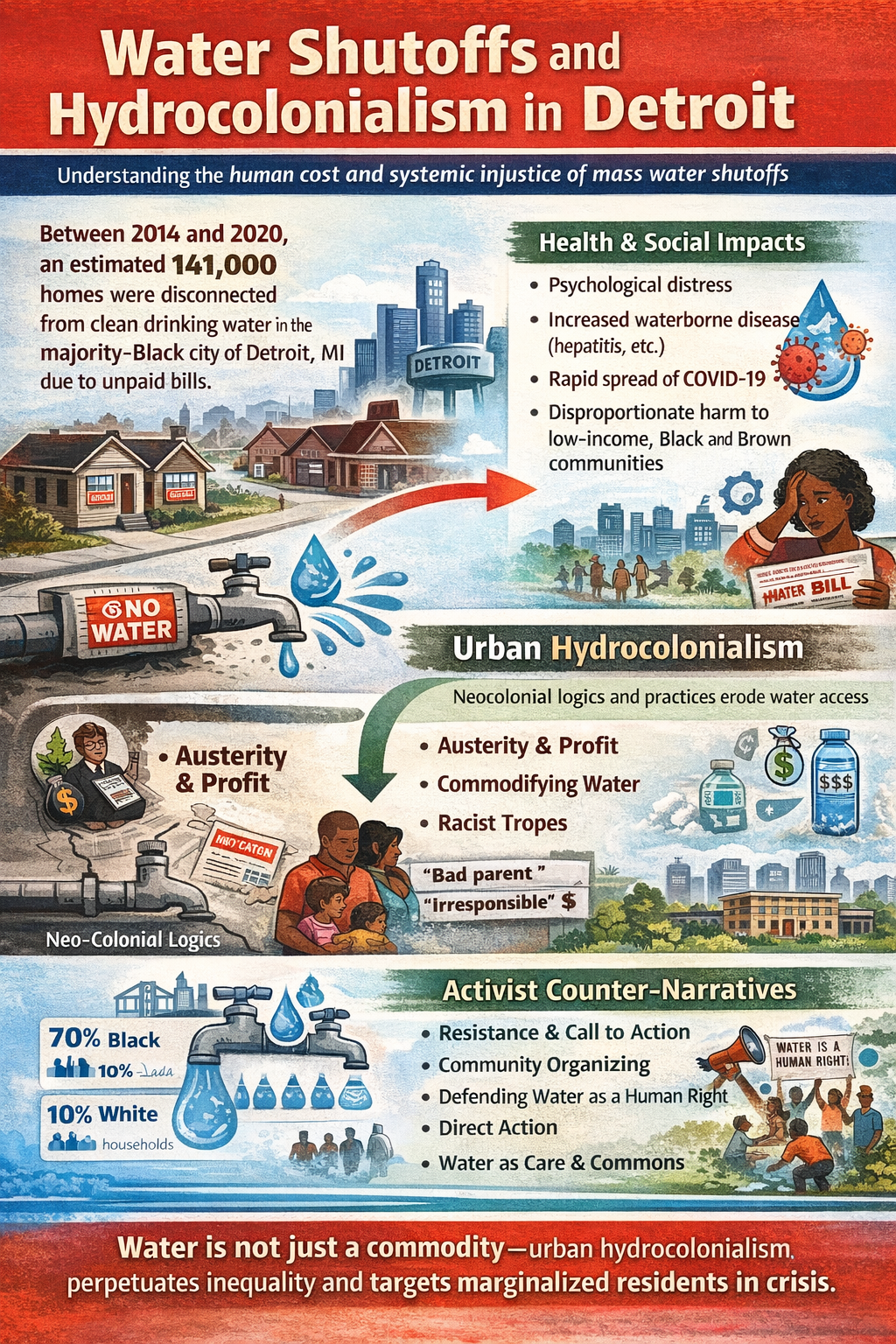
This essay reflects on the mass water shutoffs in Detroit between 2014 and 2020, during which an estimated 141,000 households lost access to clean drinking water due to unpaid bills.
In the paper, I draw on the concept of urban hydrocolonialism to think through how these shutoffs might be understood not only as a policy response to financial constraints, but also as part of a broader set of social and political dynamics. I suggest that institutional narratives—particularly those organized around place, crisis, and agency—play an important role in shaping how water insecurity is explained and justified. These narratives can, at times, obscure the lived experiences of low-income residents of color, framing disconnections as inevitable or individually driven rather than structurally produced.
At the same time, the paper focuses on the ways residents and grassroots organizers challenge these dominant framings. Drawing on ethnographic work conducted between 2018 and 2020, I highlight how counternarratives—shared through community organizing, storytelling, and public health advocacy—offer alternative ways of understanding water access. These efforts, while often under-recognized, help make visible the social conditions surrounding water insecurity and point toward more care-centered approaches to public health.
This project began as part of an interdisciplinary symposium on hydrocolonialism at University of California, Berkeley, organized by Patrick Owuor and Greg Neimeyer. That gathering brought together colleagues from the humanities, social sciences, environmental health, and visual arts, and it shaped how I approached this work. I’m grateful for the conversations that emerged there, which encouraged thinking across disciplinary boundaries.
I hope the essay contributes, in a small way, to ongoing discussions about water, equity, and urban life.

