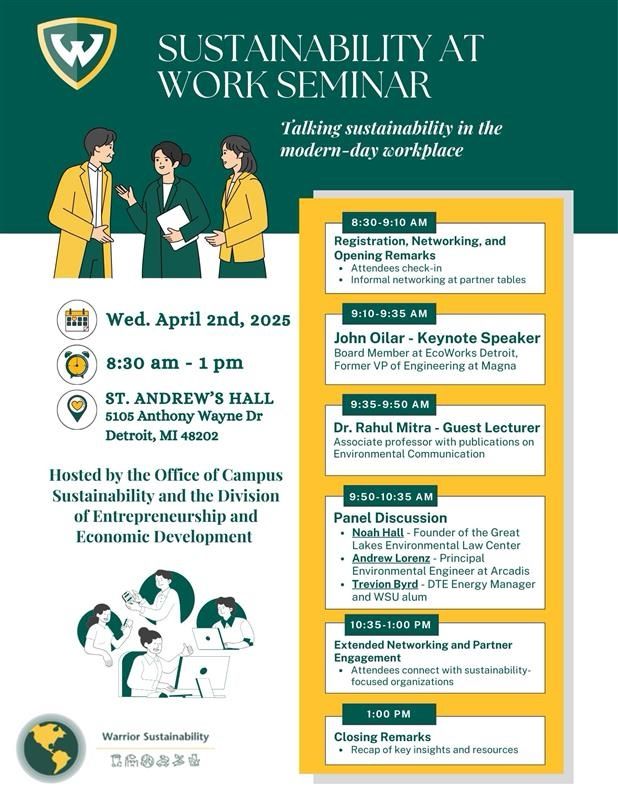
Talking about “Sustainability at Work” with WSU students

I enjoyed participating in a great conversation this week on Sustainability at Work, hosted by the Wayne State University Office of Economic Development and Office of Campus Sustainability. I gave a short “teaching talk” on why and how communication was central to how different kinds of organizations and workers engage in environmental sustainability, and afterward joined a great panel of industry representatives and scholars talking about opportunities for students to get engaged.

Great Lakes Bioneers Detroit Tour of CLEAR lab spaces at the C.S. Mott Center

Earlier today, the Research Translation team that I lead at CLEAR partnered with the C.S. Mott Center for Human Growth and Development (led by CLEAR’s Project 4 PI Dr. Gil Mor), to host around 35 high school students and community members as part of the 19th annual Great Lakes Bioneers Detroit conference.

Continue reading “Great Lakes Bioneers Detroit Tour of CLEAR lab spaces at the C.S. Mott Center”

NEW White Paper: COVID-19 and BIPOC Entrepreneurs’ Resilience in Metro Detroit

Our NEW White Paper from the RISE Lab aim to cast a light on the struggles that Black, Indigenous and People of Color (BIPOC) entrepreneurs faced during the so-called “First Phase” of the COVID-19 pandemic in Michigan (approximately March-July, 2020) and how some of them have been able to bounce back. Because BIPOC entrepreneurs have historically been excluded from resources and opportunities, now, more than ever, it is important to recognize the unique challenges that face BIPOC entrepreneurs, and to establish a well-balanced and equitable system of support for all entrepreneurs.

Continue reading “NEW White Paper: COVID-19 and BIPOC Entrepreneurs’ Resilience in Metro Detroit”

Learnshop on Tensions Model to Negotiate with Environmental Stakeholders at GLBD 2018 Conference

I was privileged to facilitate a “Learn shop” at the 14th annual conference of the Great Lakes Bioneers Detroit, targeted primarily at regional leaders working toward environmental sustainability. My own contribution centered on helping learnshop participants use communication theory to engage multiple stakeholders amid the “wicked problems” of environmental sustainability. Drawing from my research, I proposed a Tensions Model centered on recognizing how tensions can be more than just headaches, but can be used constructively once we take the time to appreciate the situation holistically from multiple perspectives. Specifically, the learnshop used four “tension areas” as the starting point to help analyze different problems in small groups.

Continue reading “Learnshop on Tensions Model to Negotiate with Environmental Stakeholders at GLBD 2018 Conference”

Communicating that Research is Inherently Practical and Applied

read

Exhorting academics to talk candidly and plainly about their research with broader publics is not exactly new. What IS new, though, in this recent op-ed piece published in the Chronicle of Higher Education, is linking it explicitly to the research-generation goal of a university, which most policymakers and publics seem to be in the dark about, or conflate with imparting particular “skills” for the job market, or “applied” research that answers a localized question in a particular setting (e.g., how can we get legislators in Wyoming to buy into man-made climate change?).

But the goal of research, and academics in general, is deeper than that, the article points out.

Continue reading “Communicating that Research is Inherently Practical and Applied”

How can we “translate” Sustainability effectively?

translate

At the close of my recent talk on “Organizing/Communicating Sustainably” at Central Michigan University, someone in the audience asked me, predictably enough, what hope there was for meaningful systemic change, given the preponderance of cultural, structural, and moral obstacles both in the U.S. and worldwide.

My response hinged around the very communicative concept of translation.

Continue reading “How can we “translate” Sustainability effectively?”